
There are many factors at play when it comes to well-being, ranging from the practical to the social and there is no panacea when it comes to getting happier. More, the paralyzing effects of depression and anxiety are real and to presume on my part to solve for these ills by advocating for a cure-all is nothing short of arrogant (and to those afflicted, insulting).
The above in mind, I would like to put forward one habit which in collusion with therapy, medications, what have you, may actually hold water where well-being is concerned.
Nope, I’m not talking about awareness training or meditation, though these are definitely tools that we should all have in our tool boxes by now.
I’m talking instead about a phenomenon adored by some, professed to be enjoyed by others, feared by most, and toward which the rest feel at best ambivalent: the act of reading.
Reading?
Yes sir!
Forget ambivalent. I hate reading.
Ok, but –
And I’m a really slow reader.
Look, me too –
I fall asleep when I read! It’s like fast acting Benadryl!
Look, I get it –
I haven’t read a book since high school!
Right there with you, friend, but these are not the obstacles you think they are relative to the payoff. And it doesn’t, by the way, have to be a book. Nor even a text in the traditional sense. But before we delve into the finer points, consider the following highly technical graphs:
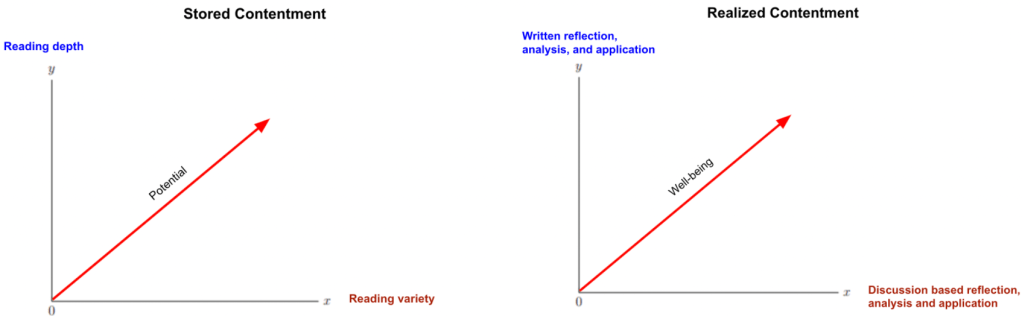
Above, we have two graphs, each pointing to a set of contentment parameters.
The Stored graph speaks to the importance of reading in so far as it aids in the accumulation of knowledge. As we learn more and more across domains, we build up stores of information in the same way that water builds behind a dam. Setting aside for the moment that learning for the sake of learning can be its own reward, the key benefit to stockpiling intelligence in this way is the potential that this intelligence can generate for you in the form of creative connection making, insight, and improved cognition, the effects of which can result in, as per the trajectory of the red line, an increase in one’s sense of well being.
The going thesis is this: the more we learn through reading, the more we bring to the table when it comes to lived experience and so the less in turn we depend on our environments to fund the insight upon which joy, rapture and awe depend.
So reading just on its own can contribute to a change in emotional weather?
Yes, with three stipulations.
First, that we welcome into the fold alongside traditional books, other mediums such as audiobooks, podcasts, discussions and even travel.
Second, that we differentiate “bait from weight” by triaging texts into two categories: the twitter post which serves merely to introduce a topic, and the dedicated follow-up effort to read profoundly about the topic introduced via Twitter.
Third, that we admit the following: a text insufficiently recalled is a text insufficiently read.
Ok, lots going on there. To shed light, let’s take a closer look at podcasting by way of example.
Yes, listening to a podcast qualifies as reading but as “bait” or “weight” it would depend: first on the podcaster’s credibility and ideological position (ideally neutral), and second on whether one has been made aware of the material through passive or active means. If you have unearthed a given podcast episode in search of an answer to a question, you have largely been actively engaged because of your having sought information to satisfy inquiry. But if you are listening to a podcast that has been recommended, or to which you subscribe, you are in bait mode, meaning, if you stumble upon an interesting fact or idea, the onus is on you to consult outside sources to the same end as has the actively motivated listener who, in the pursuit of answers, has discovered through more organic means the same podcast to which you both are listening.
That podcasting and audiobooks count as reading is mostly an aside however. The big takeaway is that regardless of whether you choose to read a traditional text or an audiobook or podcast, that there is still work to be done after you rip through your text of choice. You have to dig. Read about what you have read. Consult reliable outside sources in order to round out your understanding of a your text. In short, to get the most out of whatever you are reading long term (which is the point of this blog post) you have to do your due diligence.
What this due diligence looks like however, might surprise. Because you are not actually on a fact checking mission (though this is an important byproduct of outside reading). The motivation is different than that of the investor who reads through financial statements before purchasing stock. The primary aim in performing due diligence in the case of your reading is to ensure that you are in a position to interact more profoundly with the text long after you set it aside.
For reading is not just an act. It is a process. A process which demands a certain amount of reflection and due diligence for it to even begin to qualify as reading.
Perhaps though, you are serial reader. A fickle, philandering bookworm who devours book after book, dismissing each along the way without a second thought. First of all, good for you! Books can be a wonderful source of entertainment and distraction – and if you’re going to be promiscuous, do it with literature. But what if you could get more juice from the squeeze by doing just a little follow up reading about a particular topic introduced in one of those books?
Even then, there’s still one more step – the actual storing of that which you have read, an operation which requires, ironically, an outlet, of which there are three: writing, reflection and conversation.
Altogether forming the acronym WRC, the above vehicles represent the final step in the reading process.
Start with writing.
Writing is the ultimate outlet for the cross-curricular reader for two reasons.
First, in writing about what you have read, you are sharpening your ability to articulate concepts and ideas gleaned from your reading. This is important because of the snowball effect. The more you learn, the more you tend to enjoy learning about that which you have learned. Thinks sports. If you suck at soccer, soccer isn’t much fun. But the better you get, the more fun it is. Progress in the learning department is no different. As you begin to formulate concepts more clearly, there’s a reward there, call it a pride of ‘learnership,’ which perpetuates more learning.
The second benefit is that even as you set out to write about what you have read, one never ends up writing just about that which one has read. Personal experience inevitably sneaks into the narrative on account of the powers of association. The benefit here is that you almost accidentally end up making connections between the text and yourself, the text and other texts, and the text and the world at large. All of which manifests in a playground of creativity and innovation where ideas can interact with each other and produce new ideas. To suggest that this too is a rewarding experience is an understatement. Just wait until you start seeing it in your own writing…
Yet, writing isn’t the only conduit for your learning. Connection making and profound insight are also possible absent the pen or laptop in the form of free reflection.
Free reflection can happen anywhere really. The shower and whilst driving are probably the most common podiums. For me, it’s at 4 or 5am on the back steps(now that I’ve finally shoveled them) with a double espresso. I do it all year long, even through the insanity of the Canadian cold. Espresso. Gloves. Toque. Coat. And out to the steps.
What goes on in the mind of one who engages in free reflection is similar in nature to what occurs while writing with one exception – there’s no blank page, no pressure and no agenda. Meditate, ruminate, daydream. Whatever. The point is to carve some time out of your busy schedule and to take your ideas to that creative playground and to let them run around. The fun won’t happen right away. But build some time for yourself into your routine and stick with it. Eventually, you will see something. Or feel it. Or both. You’ll have an epiphany of some sort. It may not be the next Iphone but it will feel like it. Because it’s yours. And that is a good place to be.
The final recall strategy embodied by the WRC acronym is conversation.
Think of conversation as a form of borrowed reflection. Where free reflection means to wonder on your own time, borrowed reflection means to perform the same task on ‘borrowed’ time, i.e., on somebody else’s watch (sort of harsh sounding but the analogy is too apt not to use). To master the art of borrowed reflection, there is really only one skill required: active listening.
Active listening means not only to hear what someone is saying, but to meditate on that which is being said in the context of what you already know. Again, this is really no different in nature to what goes on when writing or during free reflection – it all adds up to connecting ideas. Whether you share your epiphanies with your audience is always a matter of tact but if and when you do, the payoff is usually big – a much more enjoyable conversation, and quite often a stronger friendship.
To sum up, I will reiterate that reading does not have to be a one and done act. The text, with just a little outside reading can stay with you forever if only as a scaffolding tool for other texts. And can subsequently serve two very important functions in your life – first it can feed your intellect. Second, it can, as you continue reading, add fuel to the fire where everything from writing to conversation to time spent alone is concerned.
Perhaps though, I have been speaking this whole time not of reading, but of learning in the general sense, for how is the process as I have described it any different than that employed by university students when studying for an exam? Fair point, especially if we start to look at the idea of a “text.” What of the expression: “to read a face,” for instance? Or “to read a situation?” Are faces and situations not by extension also texts? If we argue yes, then it is not too far a leap to assert that the process of reading, again, in so far as I’ve described it, is indeed synonymous with learning.
On other hand, if we associate learning with the plight of the university student who must study for exams by recalling information dictated by authorities who do not update either the curriculum nor their teaching methods on a regular basis enough to even attempt to motivate students to learn intrinsically, I would argue no because learning at that point lacks joy – and I for one would prefer to be reading for meaning and enlightenment – an exercise I would not at all associate with the learning methods espoused by traditional schooling.
Whatever spin you put on it, the key is to make better use of what you read by delving into the ideas presented therein. And in so doing to interact with the text long after you have set it down. And to use it as a catalyst to discover, to connect, to innovate and to hone your social and interpersonal skills.
All you have to do is choose a book, dig in and start (or keep) writing.
From there, it’s even easier: marvel at what you uncover.
JM

 The Boring Cafe